
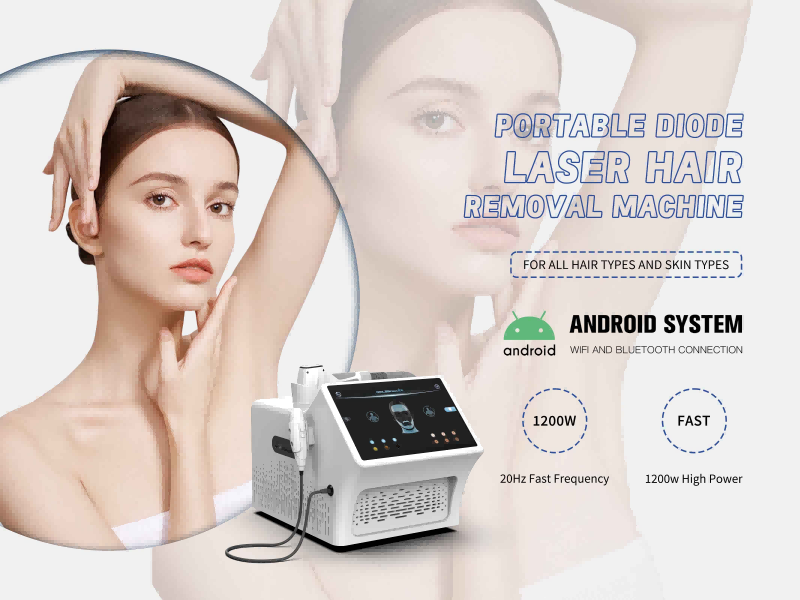
1. Laser Hair Removal Technology Enters the Era of Intelligence
Since its inception, laser hair removal technology has undergone significant evolution from fixed parameters to dynamic adjustment, and from a one size fits all approach to personalized treatment. During this technological leap, hair detector played a crucial role. As the “smart eye” of modern professional laser hair removal devices, the hair detector not only completely changes the treatment process, but also significantly improves the efficacy and safety. For professional medical beauty institutions, understanding the working principle and value of hair detectors has become the key to optimizing services and enhancing competitiveness.
2. Core Function of Hair Detector: Multidimensional Data Acquisition and Diagnosis
The hair detector is not a simple physical accessory, but a precision diagnostic system that integrates optical, sensing, and image processing technologies. Its core function is to perform deep data-driven scanning and evaluation of the treatment area before and during treatment.
2.1 Accurate Mapping of Hair Distribution and Density
Traditional laser hair removal relies on the operator’s visual assessment of hair condition, which is subjective and prone to missing details. The hair detector, through high-resolution imaging technology, can clearly display the specific location and coverage range of hair within the treatment area, avoiding treatment blind spots. Quantifying the number of hairs per unit area provides a core basis for the initial setting of energy density. The bikini line, armpits, and other areas often have dense hair, and the detector can accurately locate them, indicating the need for focused or phased treatment.
2.2 Dynamic Analysis of Hair Growth Status
The principle of laser hair removal is selective photothermal action, targeting melanin in hair follicles in the Anagen phase. The hair detector, through advanced analysis algorithms, can:
Evaluate the proportion of growth cycles: Determine the approximate proportion of hair in the current area that is in the growth, regression, and resting stages. This directly determines the immediate effect of a single treatment and the basis for developing a complete treatment plan.
Monitoring hair thickness and color: The detector can analyze the diameter and degree of pigmentation of hair. Coarse black hair absorbs laser energy well and has a significant therapeutic response. For fine and shallow hair, parameters need to be adjusted to ensure therapeutic effect. The data from the detector provides an objective standard for this differentiated processing.
3. Intelligent Analysis and Parameter Generation
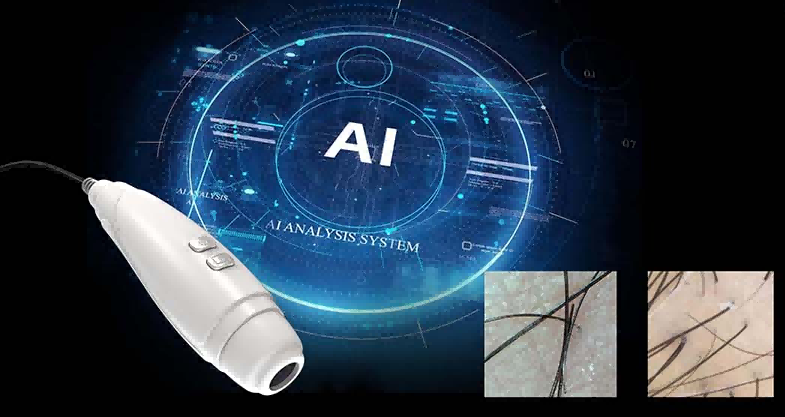
Collecting data is only the first step, and the higher value of hair detectors lies in their built-in intelligent analysis system. The system is like an experienced therapist, capable of integrating and analyzing multidimensional data, and outputting optimal treatment parameters.
3.1 Adaptive Generation of Core Parameters
Based on the collected information such as hair density, thickness, color, etc., the intelligent system will accurately calculate the most suitable treatment parameters for the current area:
Energy density: This is the most critical parameter. The system will automatically match the most efficient energy within a safe threshold based on hair pigment content and skin color. For example, in areas with lighter skin tone and coarse black hair, the system will recommend higher energy to ensure hair follicle destruction. On the contrary, it will be appropriately lowered to prioritize safety.
Pulse Width: Match based on the diameter of the hair. Thicker hair follicles require longer heating time (longer pulse width) to ensure that thermal energy is conducted from the hair stem to the surrounding stem cells of the hair follicle. Thinner hair is matched with shorter pulses to avoid heat diffusion and damage to surrounding tissues.
Wavelength selection and spot size: In some advanced devices equipped with multiple wavelengths or spot sizes, detector data can even assist operators in selecting more suitable wavelengths (such as using longer wavelengths for dark skin) and spot sizes (using large spots for efficiency in large areas and small spots for precise processing in fine areas).
4. Revolutionary Improvement of Treatment Process and Effectiveness
4.1 Before Treatment: Achieve Standardized Assessment and Expected Management
Objective communication: Through intelligent analysis, the detector can clearly display the hair condition, scientifically explain the basis for treatment plan design, and enhance professional credibility.
Accurate efficacy expectation: Based on hair cycle analysis, it is possible to more accurately predict the effectiveness of a single treatment and the total number of required treatment courses, helping customers establish reasonable expectations.
4.2 During Treatment: Ensuring Safety, Improving Efficiency and Comfort
Maximizing Security: Minimizing treatment risks, especially for dark skin or sensitive areas, through pre assessment of the skin and automatic optimization of parameters.
Significantly improve treatment efficiency: Operators do not need to repeatedly manually test or adjust parameters. The parameters recommended by the system are usually very close to the optimal solution, reducing trial and error time, shortening the single treatment time, and improving the reception capacity of the institution.
Optimizing treatment experience: Accurately matched parameters mean that energy is used on the blade, effectively destroying hair follicles while minimizing unnecessary stimulation to the epidermis, thereby improving the comfort of the treatment process.
4.3 After Treatment: Efficacy Tracking and Course Optimization
Establish digital archives: Treatment data can be archived to form a customer exclusive hair treatment database.
Quantitative efficacy comparison: In subsequent treatment courses, by comparing previous data, the proportion of hair reduction and the degree of hair thinning and lightening can be objectively and quantitatively evaluated, making the efficacy clear at a glance.
Dynamic optimization plan: Based on the response after each treatment (such as detecting a decrease in hair density or thinning hair during the next treatment), the system can intelligently adjust the parameters of subsequent treatment courses to achieve dynamic treatment management.
FAQ
Q1: Can the detector distinguish hair of different colors?
Yes, but there are certain limitations. The detector has the highest accuracy in detecting dark hair such as black and dark brown (up to 95% or more), because melanin absorbs more light and has a clear contrast. For medium colored hair such as gold and light brown, the accuracy is about 80-90%. For extremely light colored hair such as white and gray, due to the lack of melanin, detection is difficult and may require manual assistance in setting.
Q2: Can the hair detector identify the stage of hair growth?
It can be partially recognized. By analyzing the thickness, color depth, and characteristics of hair follicles, intelligent algorithms can determine the probability of hair being in the growth, regression, or resting phase. Hair during the growth phase (rich in melanin) is most easily identified and prioritized for treatment. However, 100% accurate differentiation of all growth stages still poses challenges in current household technology.