
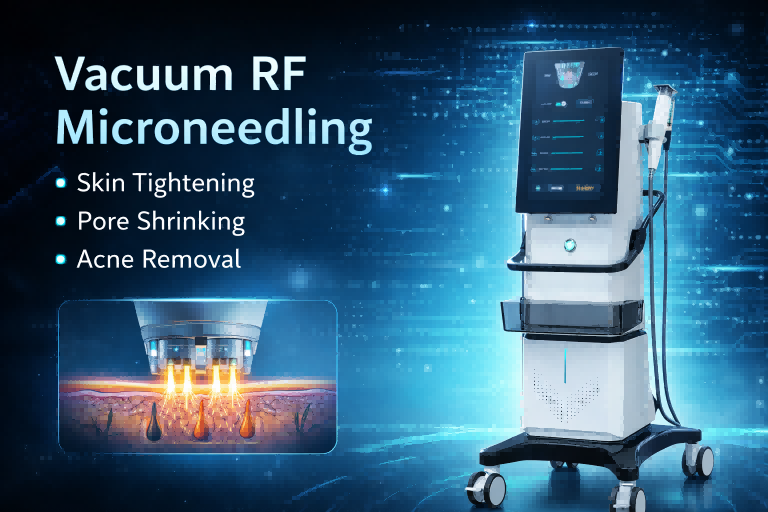
Today, with the rapid development of medical and aesthetic technology, radio frequency microneedle is no longer an ordinary project for “just getting started”, but a “must-have” for advanced skin care and anti-ageing pursuers. HoweveR, the difference in equipment determines your pain, recovery period and final effect.
This article will focus on the real changes of the skin after completing 3 radio frequency microneedle treatments, and combine with the new generation of vacuum radio frequency microneedles, it is specially designed for the treatment that requires epidermal peeling and reconstruction, and deeply analyses its four core technical advantages. Whether you are a first-time experiencer who is watching or a professional institution that wants to upgrade equipment, this article will provide you with a clear and scientific reference.
1. What Has the Skin Experienced after Three Courses of Treatment?
1.1 First Treatment: Start the Reconstruction
After the first treatment, your skin will enter a controllable period of inflammation repair. The new generation of adsorption probes use vacuum negative pressure adsorption technology to make the needle body closely fit with the skin surface at the moment of needle entry. This means:
Energy distribution is more uniform: avoid the “hot spots” or “invalid points” caused by poor contact of traditional handils.
Uneven areas such as around the eyes and neck can also be treated accurately: the adsorption function gently lifts the skin, and the needle tip acts accurately on the dermis without damaging the epidermis too much.
3-5 days after surgery: You will find that the edges of the pores become clear, and there is a slight feeling of sand and gravel on the skin, which is a manifestation of the peeling of old waste keratin and the upward movement of new cells. Oil secretion is significantly reduced, especially in the T-zone.
1.2 Second Treatment: The Superposition Effect of Collagen
The second treatment is usually carried out after 4-6 weeks. At this time, the first batch of new collagen bundles has been formed in the dermis. They are like newly woven spring nets, and begin to tighten the loose fibre spacing.
Thanks to four different sizes of treatment heads, doctors can flexibly switch between the face, around the eyes, the neck and even other parts of the body:
Small treatment head (for around the eyes): accurately treat suborbital fine lines and upper eyelid sagging, and adsorb the probe to fit the fragile skin around the eyes without pulling.
Standard facial treatment head: covers the cheeks and jaw margin, focusing on solving large pores and mild sagging.
2 weeks after surgery: You will find in the mirror that the oedema face when you get up early has improved significantly, the mandibular line begins to appear, and the foundation no longer fills the orange peel pores when making up.
1.3 The Third Treatment: The Peak Period from Quantitative Change to Qualitative Change
1-3 months after the third treatment is the real peak of the effect of radiofrequency microneedle.
The pores change from round collapse to thin line: this is not the false shrinkage caused by excessive grinding, but the pores are supported from the bottom after the collagen of the dermis thickens.
The risk of pigmentation is significantly reduced: the new generation of equipment releases radiofrequency energy to coagulate tiny blood vessels through high-efficiency haemostatic mechanism, and there are almost no bruises and no scabs after the operation. This is very good for dark-skinned people who are worried about anti-black.
After three courses of treatment, the collagen density of the dermis increases by an average of 30%-50%, and the skin’s ability to resist gravity has reached a new level.
2. Why Is It Adsorption Fusion Probe? Disassembly of the Four Core Advantages
2.1 Full Function: Not Only Facial, But Also Whole Body Anti-ageing
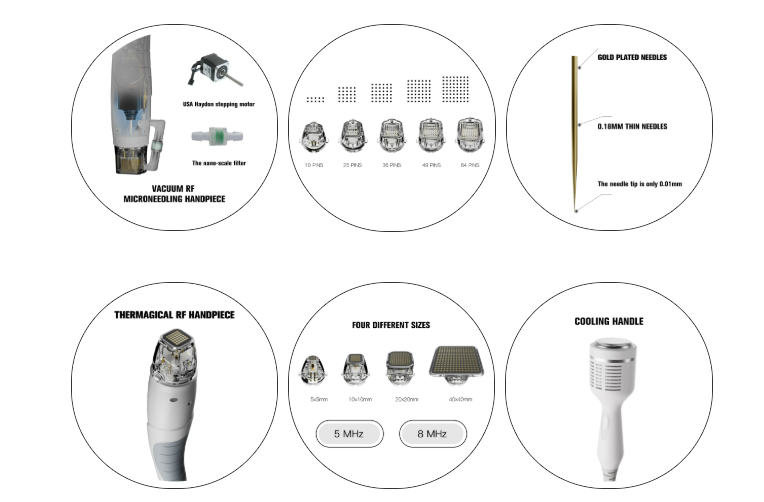
Traditional radio frequency microneedles are often limited to the face, while Nubway’s new generation of equipment is equipped with four sizes of treatment heads, covering the comprehensive needs from the eyes to the waist and abdomen:
0.18mm thin needles: extremely thin areas of the stratum corneum around the eyes and lips, which are almost painless after adsorption and fixation.
5×5 array treatment head: neck horizontal stripes, ageing of the back of the hand, quickly cover a large area.
Body-specific lengthening needle: for abdominal stretch marks and thigh cellulite tissue, the energy penetration depth is sufficient, and the adsorption function prevents sliding.
Application scenario expansion: It is not only an all-round tool for facial rejuvenation, but also for postpartum repair and body fine line management.
2.2 Comfort: Slightest Sensation of Pain
Pain is the first threshold for radio frequency microneedle to persuade most users to withdraw. The adsorption fusion probe realises comfort treatment through two major mechanisms:
- Physical fixation reduces nerve provoking: the skin is in a stable state after being adsorbed, and there is no painwhen the needle tip is pierced.
- Energy release is milder and more efficient: Due to the stable contact impedance, the equipment does not need to use too much energy to compensate for energy loss, and the treatment experience changes from “torment”to “warm acupuncture feeling”.
Clinical feedback: More than 85% of the experiencers said that they only felt a slight sucking sensation during the treatment around the eyes.
2.3 High Efficiency: Postoperative Erythema and Petechiae are Reduced by 70%
The biggest risk of side effects of radiofrequency microneedles does not come from thermal energy, but from bleeding and inflammation after mechanical damage.
At the moment of the adsorption fusion probe, the vacuum negative pressure compresses the superficial capillaries, and the radiofrequency energy immediately activates the coagulation mechanism. This means:
Immediately after the operation, there was almost no petechia in the needle, and only uniform redness.
The scab is extremely thin and even has no visible scab, and social makeup can be restored within 3 days.
The risk of pigmentation is systematically reduced: the milder the inflammation, the lower the probability of melanocytes being abnormally activated.
FAQ
Q: What is the difference between radio frequency microneedle and ordinary microneedle? How should I choose?
Ordinary microneedles mainly rely on mechanical puncture to stimulate collagen, which is suitable for people with excessive stratum corne and mild photoageing, but the improvement of sagging and large pores is limited.
The radio frequency microneedle releases radio frequency energy while piercing, heating the dermis to 55-60℃, and realising immediate collagen contraction + long-term collagen regeneration. If you have dynamic lines turning into static lines, oval pores, obvious facial swelling in the morning, etc., radio frequency microneedle is a more efficient choice.
The adsorption radio frequency microneedle is the “high-configuration version” of the radio frequency microneedle, which is especially suitable for uneven areas such as around the eyes and neck, as well as people who are sensitive to pain and worry about excessive recovery period.
Q: How long does it take between the three courses of treatment? How long can the effect be maintained?
It is recommended to have an interval of 4-6 weeks each time. This cycle not only gives the skin enough repair time, but also takes advantage of the collagen overlay window period.
After three complete courses of treatment, the effect can usually last for 12-18 months. In the future, according to the skin condition, consolidation treatment can be carried out once every 6-12 months.
Q: Does the treatment hurt? Is there any anaesthetic that can be used?
Apply the surface anaesthetic cream for 30-40 minutes before treatment. Due to the pain control advantages of the adsorption probe, most users feedback is much easier than expected, especially in traditional sensitive areas such as around the eyes and around the mouth. After adsorption and fixing, there is almost only a sense of warmth.
A very small number of extremely sensitive people can choose to use laughing gas sedation or local nerve block anaesthesia, but in most cases, surface anaesthesia is enough.