

With the increasing popularity of laser hair removal technology, consumers’ demands for treatment effectiveness, comfort, and safety have also risen. Traditional single spot laser devices often struggle to balance efficiency and safety when dealing with different thicknesses of hair, skin tones, and body parts. Driven by such demand, the Multi Spot Size diode laser hair removal device, which integrates multi spot technology and intelligent hair probe diagnosis, has emerged, marking a new era of “personalized precision medicine” in the field of laser hair removal.
1. Technical Core: Collaborative Effect of Multi Spot Size and Intelligent Hair Probe
1.1 Multi Spot Size Technology: From “One Size Fits All” to “Tailor-made”
Traditional laser hair removal devices are usually equipped with a single size spot. This is like using only one pair of scissors to trim all types of fabrics, and its limitations are obvious.
Advantages of large spot size (such as 12mm x 24mm rectangular spot)
Wide coverage area, extremely fast treatment speed, especially suitable for large flat areas such as the back and legs. Meanwhile, according to optical principles, a larger light spot can allow laser energy to penetrate deeper into hair follicles, and the energy density of the epidermis is relatively dispersed, which helps alleviate discomfort and improve treatment comfort.
The advantages of small spot size (such as 8mm x 14mm rectangular spot)
Energy is more concentrated and precise, capable of finely processing complex contours, fine hair or sensitive and fragile areas such as the upper lip, hairline, armpits, bikini line, etc. The small light spot ensures that the laser can accurately target the hair during treatment in these areas, while maximizing the protection of surrounding normal skin tissue.
1.2 Intelligent Hair Probe: From Experience Judgment to Data-driven
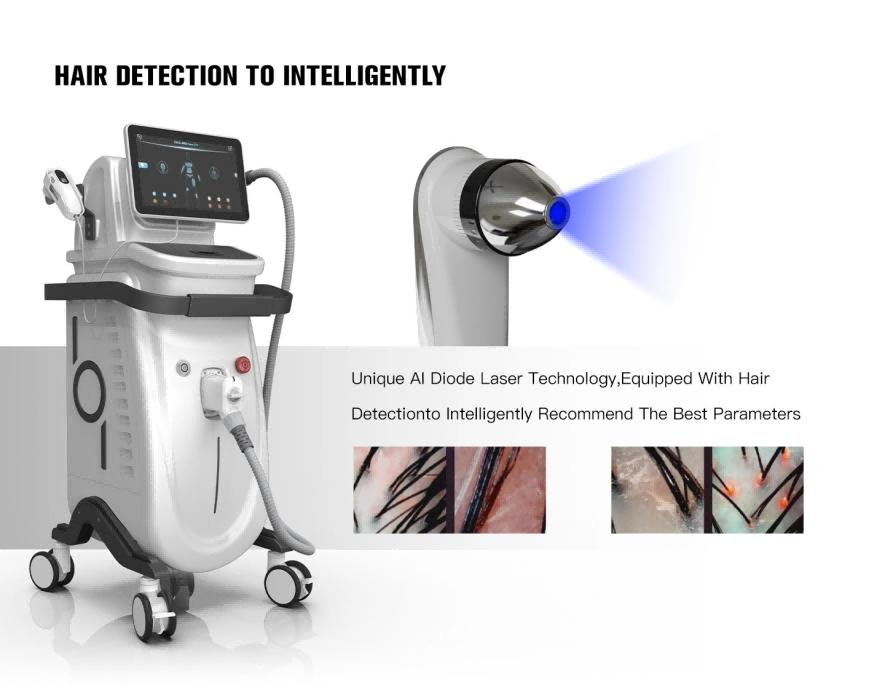
If multi spot technology provides diverse tools, then intelligent hair probes are the smart brain that guides how to choose these tools. This probe is not a simple magnifying glass, but a diagnostic device that integrates advanced optical sensors and image analysis algorithms.
Working principle: Before treatment, the physician will lightly touch the skin area of the customer to be treated with the probe. The probe will quickly capture high-definition microscopic skin images and automatically analyze key parameters.
Hair diameter and density: Accurately measure the thickness of the hair shaft and the number of hairs per unit area. Thick and thick hair requires higher energy to effectively destroy hair follicles, while fine and soft hair needs to be adjusted accordingly.
Hair color and growth cycle: Assist in determining the melanin content in hair and its growth stage (growth stage hair has the best therapeutic effect).
Skin color base (melanin) level: Evaluating the distribution of melanin in the epidermis is a key basis for setting safe energy parameters and avoiding epidermal burns or pigmentation.
Based on objective data collected by probes, the system can provide scientific treatment parameter recommendations for operating physicians, transforming treatment from a traditional mode relying on personal experience to a precision medical mode based on objective data.
2. Treatment Advantages: Comprehensive Improvement in Precision, Efficiency, and Safety
2.1 Highly Personalized, Maximizing Therapeutic Effects
For a customer with darker skin color and coarse and hard hair, the system may recommend using large light spots on the limbs in combination with higher energy that has been safely calibrated. For their fine and soft facial hair, it is recommended to use small light spots and relatively low energy. This ultimate personalized solution ensures targeted optimal energy strikes for all skin types and hair types, significantly improving the effectiveness of a single treatment and reducing the total number of treatments required.
2.2 The Treatment Process is More Intelligent and the Comfort Level is Significantly Improved
The introduction of intelligent probes makes the initial consultation and evaluation before each treatment faster and more objective. Customers can intuitively see hair analysis data, understand the basis for parameter settings, and establish a more stable sense of trust. Meanwhile, precise energy matching avoids excessive stimulation or insufficient energy caused by improper parameters. The use of large light spots itself enhances comfort, while precise energy further reduces the burning sensation and discomfort during treatment, making the entire process easier.
3. Treatment Process: Scientific and Rigorous, Step by Step to Win
3.1 Consultation and Skin Testing Stage
This is the cornerstone of the entire treatment course. The operating physician will conduct a comprehensive consultation to understand the customer’s medical history, medication history, and past hair removal history. Subsequently, an intelligent hair probe is used to detect multiple representative areas and generate a personalized skin and hair analysis report. Physicians will communicate deeply with customers based on this and set realistic treatment expectations.
3.2 Personalized Setting Stage of Treatment Parameters
Physicians select the appropriate spot size on the device based on probe report data, treatment site, and real-time feedback from customers, and input core parameters such as energy and pulse width recommended or fine tuned by the system. This step fully embodies the human-machine collaboration advantage of “data guidance, physician decision-making”.
3.3 Standard Treatment and Immediate Response Observation Stage
The treatment follows standard procedures: clean the skin, shave off the epidermal hair, apply cold gel, and wear goggles. During treatment, physicians will closely monitor immediate skin reactions (such as mild redness and swelling around hair follicles), which are important indicators of appropriate energy and can be used for real-time adjustments.
3.4 Postoperative Care and Cycle Planning Stage
Immediately apply cold compress to relieve discomfort after treatment. The physician will provide customers with detailed postoperative precautions, such as sun protection, moisturizing, and avoiding hot water washing. And according to the hair growth cycle, schedule the next treatment time (usually with an interval of 4-8 weeks) to ensure that each treatment can accurately target newly grown hair.
FAQ
Q: What is the biggest difference between this machine and traditional single spot laser or photon hair removal?
The biggest difference lies in precise customization. Traditional hair removal is like standard size, while this device is high-end customization. It uses intelligent probes for analysis and is equipped with multiple surgical knives (spot sizes) to dynamically select tools and energy for different parts, achieving the optimal balance between efficacy and safety. It is particularly outstanding when dealing with complex parts and different skin colors.
Q: Is it necessary to use an intelligent hair probe for detection? I feel like there have been additional steps.
This is the core step of precision treatment. It replaces subjective judgment with objective data, allowing physicians to see subcutaneous hair and skin color before treatment and develop scientific plans. This is like a blood test before prescribing medication, which is the key to precision medicine and can effectively avoid poor results or skin damage caused by inaccurate parameters.
Q: Is the treatment process painful? How long does the postoperative recovery period take?
The feeling of treatment varies from person to person, often resulting in a momentary warmth sensation like a rubber band bouncing lightly. The combination of multi spot technology and precise energy has significantly improved comfort. After treatment, there is usually only a brief slight redness, which can disappear within a few hours and does not affect normal life. Strictly adhering to postoperative care (especially sun protection) is the key to ensuring effectiveness and safety.
Q: Why do we need multiple treatments? How many times does it usually take?
Hair is divided into growth period, regression period, and resting period. Laser mainly acts on hair during the growth period. A single treatment cannot cover all hair follicles, so it usually requires 5-8 treatments with an interval of 4-8 weeks between each treatment to gradually achieve the desired effect. Only occasional maintenance is needed thereafter to maintain it for a long time. The specific treatment course varies from person to person.