
 With the popularization of tattoo aesthetics, the clinical demand for tattoo removal is increasing day by day. The matching of pigment characteristics, skin classification, and laser parameters of different tattoos in clinical practice remains a core challenge affecting therapeutic efficacy. This article combines the latest clinical research and pathological mechanisms, providing clinical practice references for dermatologists from four dimensions: classification, laser selection, process standardization, and cutting-edge technology.
1.Analysis of Tattoo Types and Pathological Features
The essence of tattoos is the persistent pigmentation formed by the implantation of exogenous pigment particles (particle size 100-500nm) into the dermis layer. The difficulty of removal is directly related to the physicochemical properties of the pigment particles, the depth of dermal distribution, and the reaction of surrounding tissues. The pathological characteristics of different types of tattoos vary significantly.
1.1 Professional Tattoo
The tattoo gun injects pigments into the deep dermis (from the lower part of the nipple layer to the reticular layer) through high-frequency puncture. The pigment particles are evenly distributed and wrapped in the fibroblast matrix, forming a stable “pigment collagen complex”. Laser needs to penetrate deeper tissues and require multiple treatments to destroy the complex. Clinical data shows that this type of tattoo requires an average of 7-10 treatments, with a complete clearance rate of only 38%.
1.2 Amateur Tattoo
Manual operation leads to uneven distribution and shallow layering of pigment particles (mostly limited to the nipple layer), as well as low pigment concentration and lack of stable matrix wrapping. During laser treatment, pigment particles are easily engulfed and cleared by macrophages, with an average of 3-5 times achieving ideal results and a clearance rate of over 80%.
1.3 Beauty Tattoo
The pigment contains a high proportion of titanium dioxide (white) and iron oxide (red/brown), among which titanium dioxide has a bandgap energy of 3.2 eV. After being irradiated with laser, it is prone to undergo photoreduction reaction to generate black Ti ³ ⁺ compounds, leading to temporary deepening of tattoos; Iron oxide, due to its narrow absorption spectrum, only has a weak response to the 532nm wavelength, with a clinical clearance rate of less than 50%, and is prone to induce post inflammatory pigmentation (PIH).
1.4 Traumatic Tattoos
Most of them are foreign objects (carbon particles, metal debris) embedded in the dermis, often accompanied by local fibrosis. The depth of foreign objects can reach subcutaneous tissue. Laser needs to balance the penetration of fibrotic tissue and selective absorption of foreign objects. The difficulty of removal is positively correlated with the particle size of foreign objects (the removal rate decreases by 40% when the particle size is greater than 500nm).
1.5 Medical Tattoos
As for the positioning markers of radiotherapy, the pigments are mostly medical dyes such as methylene blue, with shallow distribution and limited range. Treatment mainly focuses on local fading, and secondary damage to the skin after radiotherapy by laser should be avoided.
2.Laser Selection Principle Based on Pigment Characteristics
The core of laser therapy is to match the wavelength of pigment absorption peak, and the pulse width should be ≤ the thermal relaxation time of pigment particles (<10ns), in order to achieve “precise fragmentation and minimally invasive removal”.
2.1 Blue/Black Tattoo
The main components of blue melanin are carbon black and phthalocyanine blue, with absorption peaks ranging from 600 to 1064nm. Q-switched ruby laser (694nm), Q-switched Nd: YAG laser (1064nm), and emerald green gemstone laser (755nm) are all effective choices.
Ruby laser (694nm): with a large spot size (4-6mm) and deep penetration (1.5-2mm), a controlled study by Leuenberger et al. showed that its removal efficiency for blue black tattoos is 22% higher than that of Nd: YAG laser, but the absorption rate of epidermal melanin is 65%. The incidence of PIH in Fitzpatrick IV-VI skin patients is 31%, and it is only suitable for light skinned individuals.
1064nm Nd: YAG laser: epidermal absorption rate<10%, penetration depth up to 4mm. Moustafa et al.’s research has confirmed that its effective rate for cosmetic eyebrow tattoo treatment of V-VI type skin is 76%, and the incidence of hypopigmentation is only 5%. It is the first choice for deep skin and deep tattoos.
2.2 Red Tattoo
The red pigments are mostly Alizarin Red and azo dyes, with an absorption peak of 532nm. The 532nm Nd: YAG laser is preferred, but the epidermal absorption rate at this wavelength reaches 40%. Research on Asian populations by Kono et al. shows that the incidence of PIH after treatment is 28%. It is recommended to use a “low-energy, multi frequency” regimen (energy density ≤ 2J/cm ², with an interval of 12 weeks) to reduce the incidence of adverse reactions to below 10%.
2.3 Green Tattoo
Green pigments are mostly phthalocyanine green, with an absorption peak at 755nm. The gold standard is the emerald green laser (755nm), and in vitro experiments by Cecchetti et al. have confirmed that its fragmentation efficiency for phthalocyanine green is 35% higher than that of the 694nm ruby laser; However, during the laser treatment, the pain VAS score reached 6-7 points, and the incidence of blisters was 18%. It is recommended to use lidocaine local infiltration anesthesia before surgery, and the treatment interval should be ≥ 2 months to reduce the risk of scars.
2.4 Light Colored Tattoos (yellow/orange/purple)
This type of pigment has no clear absorption peak, and the existing laser treatment is limited. Bernstein et al.’s research shows that 730nm picosecond laser can cover the absorption range of purple pigment, with a clearance rate of 55% after 3 treatments; However, yellow/orange pigments remain a clinical challenge and require combined chemical exfoliation (such as low concentration fruit acid) pretreatment to improve laser penetration.
3.Standardized Treatment Process and Key Operational Points
The entire process of tattoo laser treatment needs to be designed around “reducing normal tissue damage and maximizing pigment removal”, with clear pathological and physiological support for its operational points.
3.1 Preoperative Evaluation
The collection of medical history should focus on the history of treatment with isotretinoin (isotretinoin can inhibit fibroblast activity, increase scar risk, and it is recommended to stop treatment for 6 months), and the history of herpes infection (requiring preoperative prophylactic antiviral treatment).
The Kirby Desai scale is used to quantify the number of treatments. If the score for the scar/tissue change item in the scale is ≥ 3 points, fibrosis tissue needs to be pre treated with dot matrix laser, otherwise the clearance rate will decrease by 30%.
Preoperative skin microscopy imaging is taken to clarify the “clumpy” or “diffuse” distribution of pigments. Lumpy pigments require high-energy single point treatment, while diffuse pigments require low-energy full coverage.
3.2 Intraoperative Procedures
The endpoint of treatment is immediate frost white reaction, which is essentially the formation of air bubbles in the dermal tissue (caused by laser energy leading to water molecule vaporization). It is necessary to control the energy to the “minimum threshold for producing frost white” (such as 1064nm laser energy density of 2-3J/cm ²) to avoid excessive energy induced dermal necrosis.
The overlap rate of the light spot should be controlled between 10% and 20%. Excessive overlap can lead to local energy accumulation and cause epidermal peeling, while insufficient overlap can result in incomplete pigment removal.
3.3 Postoperative Management
Postoperative ice compress for ≥ 60 minutes, the mechanism is to constrict blood vessels and inhibit histamine release, which can shorten the time for redness and swelling to subside by 50%.
For 10-14 days, topical antibiotic ointment (such as erythromycin) is used to treat colonized bacterial infections after laser micro injury. Studies have shown that standardized medication can reduce the infection rate from 8% to 1%.
Treatment of pigmentation abnormalities: PIH requires topical application of hydroquinone (4%) combined with azelaic acid, while depigmentation requires 308nm excimer laser stimulation for melanocyte migration, with a treatment period of no less than 3 months.
4.Technological Frontiers and Future Development Directions
 The traditional Q-switched nanosecond laser can no longer meet the cleaning needs of complex tattoos. In recent years, technological innovation has achieved breakthroughs in three dimensions: “laser pulse characteristics”, “combined treatment strategy”, and “ink improvement”.
4.1 Optomechanical Effects of Picosecond Laser
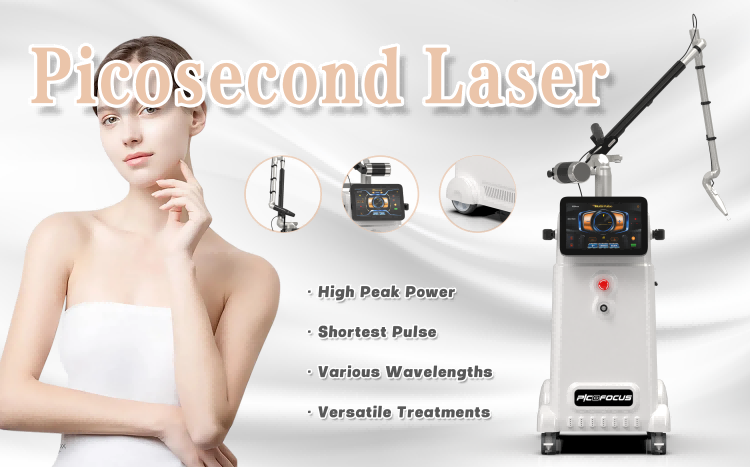
The picosecond laser pulse width (10-12 ps) is much smaller than the thermal relaxation time of pigment particles (<10ns), and its mechanism of action shifts from photothermal fragmentation to optomechanical fragmentation. It can crush pigment particles to<100nm (a particle size that macrophages can directly engulf) without damaging surrounding tissues. The meta-analysis by Pedrelli et al. showed that the clearance rate of 3-6 sessions of picosecond laser treatment was ≥ 75%, which was 20% higher than that of nanosecond laser treatment, and the incidence of hypopigmentation was only 8%. The 730nm picosecond laser can also cover the absorption range of violet/green pigments, filling the gap of traditional lasers.
4.2 Collaborative Mechanism of Laser Combined Therapy
Dot matrix laser (ablative/non ablative) combined with Q-switched laser has been a hot topic in recent years. Conforti et al.’s research has confirmed that immediate application of dot matrix laser (energy density 5-10mJ/cm ²) after Q-switched laser can activate macrophage activity through micro damage repair response, increasing pigment clearance rate by 25%. At the same time, the thermal effect of the dot matrix laser can close small blood vessels, reducing the incidence of blisters from 15% to 5%.
4.3 Innovation in Single and Multiple Treatment Techniques
The R20 method (4 treatments with a 20 minute interval) and R0 method (immediate re treatment after applying perfluoronaphthalene to eliminate whitening cream) can remove more pigments in a single treatment. Kaminer et al.’s study showed that the 1064nm laser combined with a sonic pulse device (to remove bubbles generated during treatment) can achieve 30% pigment fading in a single treatment, which is equivalent to the effect of traditional two treatments. However, it should be noted that the long-term scar risk of this plan still needs to be validated through large-scale studies.
4.4 Microencapsulation Can Remove Ink
Microencapsulated ink encapsulates water-soluble pigments in polylactic acid glycolic acid (PLGA) microcapsules, and laser only needs to destroy the microcapsule wall (rather than pigment particles). Animal experiments have shown that a single laser can remove 80% of the pigments. The core of this technology is the laser response threshold of the microcapsule wall (which needs to be matched with commonly used clinical laser wavelengths). It has entered phase I clinical trials and is expected to achieve controllable tattoo removal in the future.