
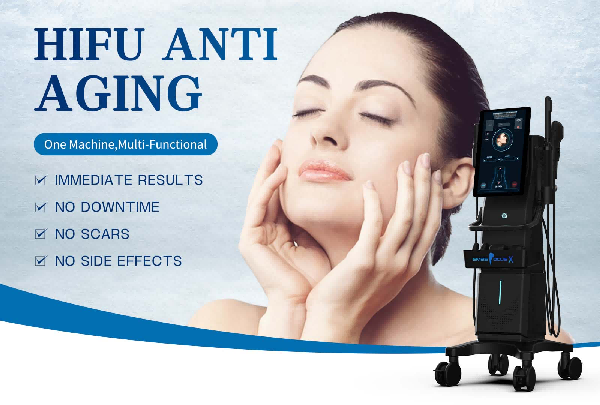
1. Single-line Handel: Precision Facial Contouring Tool
Single-line handle adopts a single row energy output design. Treatment area is precision and controllable. The energy works on micro-targeted area. Focusing ultrasonic energy at specific dermis(usually 1.5-4.0mm), it generate thermal effect immediately, making SMAS layer shrink and stimulating collagen regeneration. The handle features a lightweight design and an ergonomic grip angle, making the operation more easy and effortless. This handle is perfect for facial area with complex curves and small treatment area.
1.1 Main Adaptation Areas and Treatment Advantages
Forehead treatment: For frown lines, the single-line handle can be used to treat them line by line along the muscle curves to avoid damaging the forehead muscles. Energy can precisely act on the junction of the dermis and superficial muscle tendon system, promoting collagen remodeling without affecting the naturalness of facial expressions.
Chin and mandibular margin contour shaping: Single-line handle can achieve V-line shaping and double chin improvement by treating the attachment points of mandibular fat pad and cervical latissimus muscle. The energy of each treatment point can be independently adjusted to adapt to the differences in tissue thickness in different parts, avoiding discomfort caused by overtreatment.
Neck fine line repair: For the broad neck muscle cords and horizontal neck lines, the handle can be used to lay points vertically in the direction of the lines, and the energy penetration depth is controlled at about 2.0mm, ensuring the contraction effect of the fibrous septum and protecting the deep vascular and nerve structures.
1.2 Operation Skills and Precautions
During treatment, maintain a 30% overlap rate between adjacent treatment points to ensure continuous energy distribution. For areas with skin thickness less than 2mm (such as the outer side of the eye), the energy intensity needs to be reduced by 15-20%. During the treatment process, real-time observation of immediate skin reactions is necessary. When mild erythema appears, it indicates that the energy has reached the ideal threshold.
2. Multi-line Handle: Revolution of Full-face Youthfulness
2.1 Dual Improvement of Treatment Efficiency and Effectiveness
Time efficiency revolution: Traditional single-line handles take about 90-120 minutes to complete full face treatment, while multi-line handles can compress time to 25-35 minutes through large-area coverage. This not only improves the patient turnover rate of the clinic, but also significantly reduces patient fatigue and anxiety during the treatment process.
Energy distribution optimization: Manually moving a single-line handle is difficult to ensure energy uniformity, often resulting in regional differences in treatment effectiveness. The automated dot distribution system of multi-dot matrix eliminates the variables caused by the stability of the operator’s hands, making the thermal stimulation on the SMAS layer evenly distributed in three-dimensional space. Clinical data shows that the consistency of collagen proliferation response is improved by more than 40%.
Depth adjustable function: The advanced model is equipped with three levels of depth adjustment: 1.5mm, 3.0mm, and 4.5mm, which can implement layered treatment for the epidermis, dermis, and fascia layers. For example, tightening the SMAS layer with a depth of 3.0mm in the cheekbone area, while improving the texture of the epidermis with a depth of 1.5mm, achieves multi-level rejuvenation.
2.2 Clinical Indications Extension
In addition to basic facial lifting, this handle has been proven to have significant effects on moderate facial fat accumulation, early sagging of cheek fat pads, and reconstruction of deep support structures for nasolabial folds.
3. Booster Handle: A Precision Tool for Dynamic Area Therapy
3.1 Integration of High Frequency Pulse and Sliding Technology
The enhanced handle adopts millisecond level high-frequency pulse output (5-7 times per second), combined with continuous sliding operation mode, creating a “dynamic thermal accumulation” effect. Unlike traditional fixed point therapy, energy forms continuous thermal channels within the tissue during the sliding process, making it particularly suitable for handling linear wrinkles and curved contours. The micro cooling device equipped at the front end of the handle can reduce the skin temperature during each pulse interval, ensuring that energy is concentrated in the subcutaneous target layer.
3.2 Treatment Plan for Special Areas
Periocular rejuvenation: For crow’s feet and upper eyelid laxity, the operator slides along the orbital bone margin for treatment. The pulse frequency can be adjusted to 3-4 times per second to increase safety, and the thermal effect promotes the contraction of the orbital fascia without damaging the thin and tender eyelid skin.
Compound treatment for nasolabial folds: The treatment of nasolabial folds requires a “combination of deep and shallow treatment” strategy, first strengthening the nasolabial fold ligament support with a depth of 3.0mm, and then treating superficial wrinkles with a depth of 1.5mm. Fine parts such as the ridges and labia can be treated with specially designed micro treatment head attachments to achieve millimeter level precision heating.
Eyebrow arch and frontotemporal transition zone: By sliding in an arc from the brow to the tail of the eyebrow, the curve of the brow arch can be reshaped while lifting the relaxed tissue in the temporal region. Attention should be paid to hairline protection during treatment in this area, and the intelligent boundary recognition function of the handle can automatically adjust the energy output of the edge area.
3.3 Special Characteristics of Operational Techniques
The sliding speed is directly related to the effect, with an ideal speed of 2-3 millimeters per second. If it is too fast, there will be insufficient heat accumulation, while if it is too slow, it may cause overtreatment. During operation, the handle should be kept completely perpendicular to the skin, with even and moderate pressure to ensure that the treatment head is completely in contact with the skin. Curved area treatment requires segmented sliding, with each segment not exceeding 3 centimeters in length to ensure energy continuity.
4. Private Handle: A Targeted Solution for Pelvic Floor Repair
4.1 Analysis of Pelvic Floor Targeted Therapy Techniques
The private dedicated handle adopts a 360°automatic rotation design, combined with a micro ultrasound probe inside the vagina, achieving a revolutionary breakthrough in intracavitary treatment. Its core technology includes: 1) dual depth focusing system (3.0mm targeting muscle layer, 4.5mm acting on fascia layer). 2) Circular emission array ensures uniform heating of the entire circumference of the vagina. 3) Real time impedance monitoring and automatic adjustment of energy to avoid mucosal damage.
4.2 Multi Level Pelvic Floor Repair Mechanism
Muscle layer exercise: A 3.0mm deep treatment head produces a mild thermal effect of 45-50 ℃, stimulating protein denaturation and contraction of pelvic floor muscles (especially pubococcygeal muscles), similar to “non-invasive Kegel exercises”. Clinical studies have shown that muscle contractility can be immediately increased by 30-40% after a single treatment.
Tightening of fascial layer: Energy penetrates into the pelvic fascia and pubic cervical fascia at a depth of 4.5mm, and the thermal effect promotes the conversion of type III collagen to type I collagen, enhancing the tension of the fascial network structure. This is particularly crucial for improving vaginal vault protrusion and rectal protrusion.
Mucosal regeneration promotion: Mild thermal stimulation can increase vaginal wall blood flow perfusion by 50-70%, promote stem cell differentiation into mucosal epithelium, increase glycogen content, and improve vaginal environment. The rotation therapy mode avoids the thermal non-uniformity that may be caused by traditional point therapy.
4.3 Indications and Treatment Standards
Postpartum repair: It is recommended to start treatment at 6 months postpartum, targeting pelvic floor muscle tears and fascial relaxation caused by childbirth. The treatment plan usually consists of three sessions per course, with an interval of 4-6 weeks, with a focus on strengthening the bladder neck support point and perineal area.
Menopausal mucosal atrophy: In response to vaginal dryness and painful intercourse caused by a decrease in estrogen levels, the treatment intensity needs to be reduced by 20%, with a focus on stimulating the submucosal vascular plexus and improving mucosal thickness. Can be combined with superficial treatment (1.5mm) to achieve full layer repair.
Mild stress urinary incontinence: By strengthening the support of the urethral tissue and bladder neck, the closure pressure of the urethra can be improved. The treatment pathway needs to be specially designed in an inverted “U” shape, covering the entire urogenital diaphragm area.
4.4 Safety Protection and Effectiveness Maintenance
The handle is equipped with a disposable sterile probe cover and real-time temperature monitoring to ensure safe treatment. After treatment, it is recommended to cooperate with pelvic floor muscle training to consolidate the effect, which usually lasts for 12-18 months. Regular maintenance and treatment can be extended to 2-3 years.
FAQ
Q1: Can the four types of handles be used in combination during the same treatment?
It is recommended to use it in combination. Usually, a multi-line handle is used for large-area treatment, followed by a single-line handle for fine carving of the nasolabial folds, eye area, and other areas. Finally, a booster handle is used to treat dynamic wrinkles. The private handle is an independent treatment system. When used in combination, attention should be paid to total energy control to avoid tissue overheating.
Q2: What should be the treatment frequency for various types of handles?
It is recommended to undergo comprehensive treatment once a year for facial handles, and maintenance treatment can be carried out locally after 6-8 months. The initial treatment course for the private handle is 3 times, with an interval of 1 month between each session, followed by maintenance treatment every 6-12 months. The specific frequency needs to be personalized according to age, skin laxity, and collagen metabolism ability.