
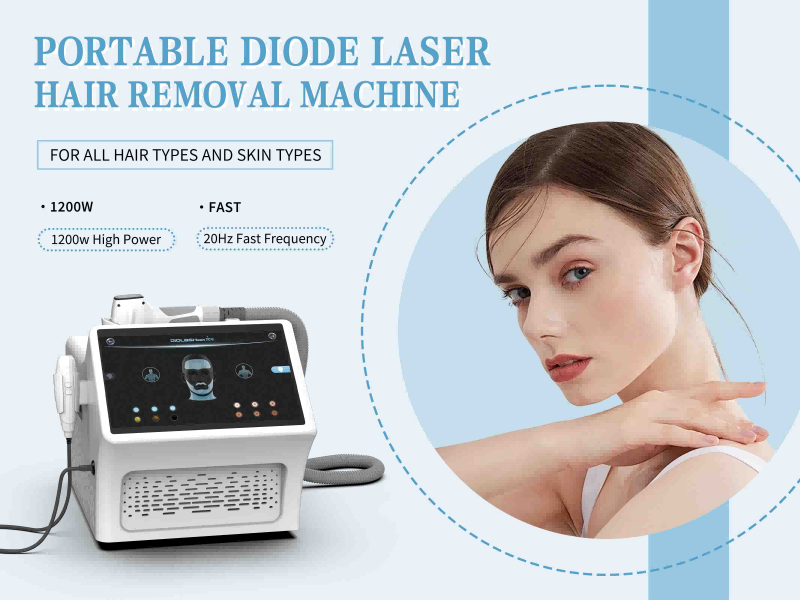
1. Scientific Base of Diode Laser Hair Removal: Understand Hair Growth Cycle
1.1 Biological Principles of the Three Stages of Hair Growth
Hair follicle is not a continuous active tissue, but follows a precise cycle period.
- Anagen phase: Hair follicles actively grow in this phase. At this time, the hair follicle contains a large amount of melanin, which is sensitive to laser.
- Catagen phase: It’s a transition phase. The follicles begin to atrophy.
- Telogen phase: This is the dormant phase of the hair follicle, during which the hair eventually falls out. This cycle varies across different body parts and individuals, and typically lasts from 2 to 7 years.
1.2 Mechanism of Laser Selective Photothermal Decomposition
The core principle of diode laser hair removal is selective photothermal decomposition. Laser with specific wavelengths (usually 808-810nm) can penetrate the epidermis and be selectively absorbed by melanin in hair shafts and follicles, converting it into thermal energy. This thermal energy precisely destroys hair papilla and hair follicle stem cells, inhibits hair regeneration ability, and has minimal impact on surrounding skin tissue.
The key is that only hair in the growth stage contains enough melanin to effectively absorb light energy, which explains why hair removal requires multiple treatments – each treatment can only target the hair follicles in the growth stage at that time.
2. Breakthrough in Portable Technology: How to Achieve Miniaturization of Professional Effects
2.1 Innovation of Energy Output System: Starting from 2000W Super Power.
Traditional concepts believe that professional medical equipment has significant effects due to its strong power, while household equipment has limited effects due to power limitations. However, the latest generation of portable hair removal devices has achieved high-energy output for small devices through breakthroughs in energy storage and pulse release technology.
The combination of 2000W machine power and high-power handle tools enables household devices to release energy density close to that of professional instruments, which is the technical basis for ensuring effectiveness.
2.2 Revolution of Refrigeration System: Comfortable Experience at -30 ℃
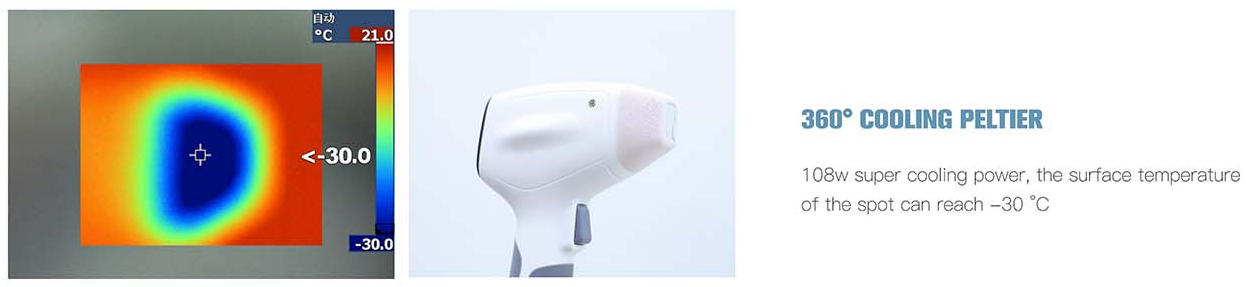
Pain is the main obstacle that hinders many people from accepting laser hair removal. The portable hair removal device achieves a localized low-temperature environment inside the handle through an integrated thermoelectric cooling system.
Sapphire contact surface is an ideal material due to its excellent thermal conductivity and transparency, which can ensure efficient laser penetration and conduct low temperatures to the skin. The combination of pre cooling, synchronous cooling, and delayed cooling significantly reduces the temperature of the epidermis before and after laser pulses, significantly reducing pain and achieving a “comfortable and painless” treatment experience.
3. Effect Verification: Real Data on Efficiency and Cycle Time
3.1 Scientific Basis for Treatment Cycle: Why Only 3-5 Times are Needed
Professional hair removal typically requires 6-8 treatments, while advanced portable devices claim to only require 3-5 treatments. This difference is due to the optimization of the energy output mode. Traditional devices use low-frequency and long pulse width methods, which result in more dispersed energy.
The new device uses 10Hz (some devices up to 20Hz) sliding therapy, combined with high-energy short pulse output, to cover more hair follicles per unit time, and the energy is more concentrated on key structures of hair follicles. Meanwhile, stronger single energy means that each treatment can destroy a higher proportion of growing hair follicles, thereby reducing the total number of required treatments.
3.2 Clinical Efficacy Evaluation: Analysis of Long-term Hair Loss Rate
According to multiple independent studies, high-quality portable diode laser hair removal devices can achieve a long-term hair reduction rate of 70-90% when used correctly. The key variables include device energy parameters, user skin type, hair color and density, as well as usage frequency and technique. a
Compared with professional equipment, the main limitations of household devices are energy limits and operational expertise, but by increasing the number of treatments and strictly following usage guidelines, the final effect can approach professional levels.
4. Security System: The Meaning Behind Triple International Certification
4.1 The Value of Medical-grade Certification: ISO13485, TUV Medical CE, and FDA
The ISO13485 system certification indicates that the manufacturer has established a medical device quality management system that complies with international standards. TUV Medical CE certification confirms that the product complies with the safety and health requirements of the EU Medical Device Directive.
The FDA certification represents that the device has passed the review of the US Food and Drug Administration, confirming its safety and effectiveness. These triple certifications constitute the highest safety standard combination for current consumer grade medical beauty equipment, ensuring that the equipment meets medical grade requirements in all aspects of design, production, and testing.
4.2 Safety Protection Mechanism: Multiple Safeguards to Prevent Skin Damage
In addition to basic certification, the high-quality portable hair removal device also integrates multiple active safety functions: real-time skin optical detection can automatically identify skin color and adjust energy parameters to avoid excessive heating of dark skin.
Contact sensing technology ensures that laser pulses are only released when in full contact with the skin. The energy gradient setting allows users to gradually adapt from low energy. These designs greatly reduce the risk of adverse reactions such as burns and pigmentation.
5. Market Comparison: Analysis of the Differences between Portable and Professional Devices
5.1 Comparison of Technical Parameters: Balancing Power, Wavelength, and Spot Area
Professional hair removal equipment typically has higher single pulse energy (up to 100J or more) and larger spot area (up to 15 × 35mm), resulting in faster treatment speed. Portable devices achieve sufficient energy density (usually 5-20J/cm ²) to destroy hair follicles in a smaller volume through optimized optical systems and energy transfer efficiency.
The wavelength of 808-810nm is widely recognized as the golden wavelength for hair removal, and is widely used in both professional and household devices because it can balance penetration depth and melanin absorption rate.
5.2 Usage Scenarios and Cost-benefit Analysis
Professional hair removal treatment is expensive for a single session (usually hundreds to thousands per session), but the effect is relatively rapid. Portable devices have a high one-time investment (with high-quality products priced between 2000-5000), but they can be used infinitely and have significant long-term economic benefits. In addition, the privacy and convenience of portable devices are irreplaceable advantages, allowing users to receive treatment at home at any time, avoiding time costs such as appointments and travel.
6. Guide to Proper Use: Practical Suggestions for Maximizing Results
6.1 Preparation and Treatment Techniques
Before treatment, it is necessary to scrape off the epidermal hair to ensure that the laser energy can reach the hair follicle directly instead of being absorbed by the surface hair. Clean and thoroughly dry the skin, avoiding any residue of cosmetics or skincare products. According to the instructions, it is recommended to start with low energy and gradually adjust to an effective and comfortable energy level. Adopting a systematic sliding or tapping mode to ensure uniform coverage of each area and appropriate overlap between adjacent pulses.
6.2 Treatment Interval and Long term Maintenance
Set appropriate treatment intervals for different body parts: once every 2-4 weeks for the face and once every 4-6 weeks for the body, which corresponds to the average growth cycle of hair in each part. After completing the initial cycle (3-5 times), enter the maintenance phase and receive treatment every 3-6 months to cope with occasional new hair growth. It is worth noting that hormonal changes (such as pregnancy, menopause, or certain medication use) may stimulate new hair growth and require additional targeted treatment.
7. Limitations: Which situations are Not Suitable for Portable Laser Hair Removal?
7.1 Physiological limitations: Consideration of skin color and hair color
The principle of laser hair removal relies on the absorption of light energy by melanin, so its effect on light colored hair (gold, gray, white) is limited because these hairs lack sufficient melanin.
Extremely dark skin color (Fitzpatrick V-VI type) also requires caution, as melanin in the epidermis may competitively absorb energy, increasing the risk of burns. However, some new devices are equipped with intelligent skin color detection, which can automatically adjust parameters to expand the applicable population range.
7.2 Medical Taboos: Situations that Need to be Avoided from Hair Removal
The following situations are not suitable for laser hair removal: pregnancy or lactation (lack of sufficient safety data). The skin area with active infection or inflammation. History of keloid lesions. Recently used photosensitive drugs. Suffering from active periods of certain skin diseases such as psoriasis and eczema. And areas with a history of skin cancer or suspected lesions. People with a history of epilepsy or sensitivity to strong light should also use it with caution.