
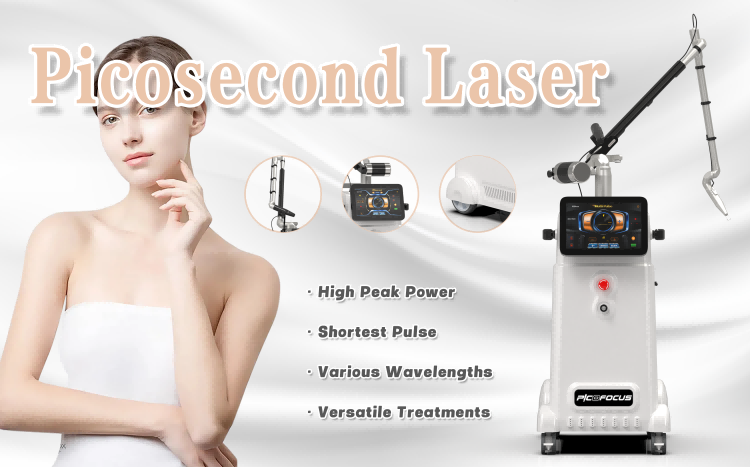
Picosecond laser has become one of the core tools in modern cosmetic medicine for treating pigmentary skin problems. It can precisely act on different pigment particles through extremely short pulse width and adjustable wavelength, achieving efficient and safe skin purification and whitening effects. This article will delve into the working principle of picosecond lasers and focus on analyzing the differences in pigment types and clinical effects targeted by different wavelengths (such as 1064nm, 532nm, 585nm, 650nm, 755nm), providing clear references for professional practitioners and beauty seekers.
1. Core Technological Advantages of Picosecond Laser
Picosecond laser, as the name suggests, has a pulse width of picoseconds (1 picosecond=10 ⁻¹² seconds). Compared to traditional nanosecond lasers, its action time is extremely short, and it can generate strong optomechanical effects (photoacoustic effects) within pigment particles, thereby shattering pigment particles into smaller dust like fragments. These tiny fragments are more easily engulfed and metabolized by macrophages in the skin, and ultimately excreted from the body through the lymphatic system.
2. Key Technical Features Include
2.1 Ultra Short Pulse Width (such as 450ps)
This is the basis for the high efficiency of picosecond lasers. A very short pulse time means that laser energy is released in a very short period of time, which can more efficiently crush target pigments while minimizing thermal diffusion and damage to surrounding normal tissues. This perfectly conforms to the theory of “selective photothermal reaction” and achieves true precision treatment.
2.2 Top Hat Beam
Unlike traditional Gaussian beams (with a high energy distribution center and low edges), a top Hat Beam has a uniform energy distribution throughout the entire spot range. This ensures that the laser energy can be uniformly and efficiently transmitted to the target tissue, significantly reducing the risk of damage to surrounding tissues while maximizing the therapeutic effect, and improving the safety and comfort of treatment.
2.3 High Transmission Efficiency Laser Arm
Adopting imported 7-joint articulated laser arms (such as those imported from South Korea), ensuring minimal loss of laser energy during the transmission process from the generator to the handheld device. This not only ensures that the energy reaching the skin is sufficiently high and stable, but also enhances the flexibility and accuracy of device operation.
2.4 Multi Wavelength System
One device integrates multiple wavelengths (1064nm, 532nm, 585nm, 650nm, 755nm, etc.) and dot matrix hand tools, enabling it to comprehensively address various skin problems caused by different pigment types, depths, and causes, achieving “one-stop” comprehensive treatment.
3. Details of Pigment Types and Effects Targeted by Different Wavelengths
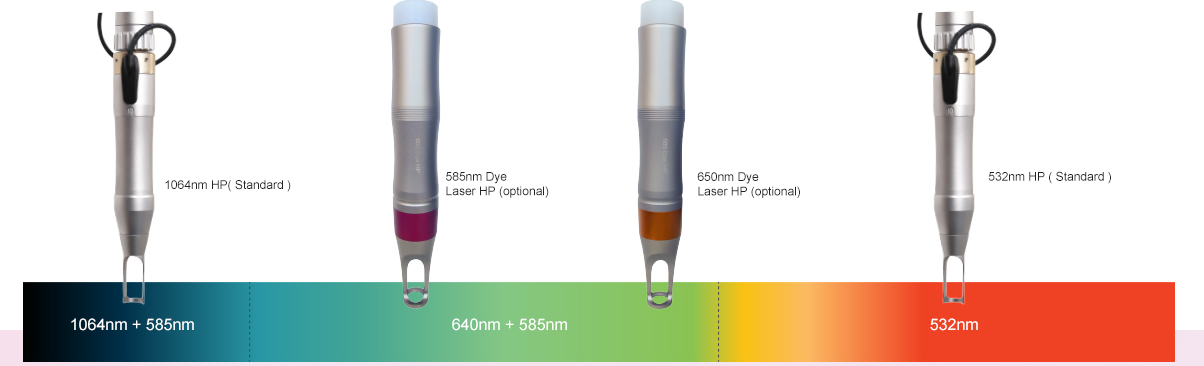
Pigments in the skin, such as melanin, hemoglobin, and exogenous tattoo ink, have specific absorption characteristics for light of different wavelengths. Picosecond laser can accurately target different chromophores by selecting specific wavelengths, achieving therapeutic goals.
3.1 1064nm Wavelength: Target Deep Melanin and Blue/Black tattoos
Target pigment types: melanin (dermis), blue/black tattoo ink.
Penetration depth: The deepest, effectively reaching the deep layers of the dermis.
Main applications and effects:
Ota nevus and zygomatic brown blue nevus: These melanocytic proliferative diseases of the dermis layer, with a wavelength of 1064nm, are the preferred treatment option due to their strong penetrating power. Picosecond mode can crush it more gently and effectively, reduce the number of treatments, and relatively lower the risk of postoperative blackening.
Deep sunspots and age spots: For stubborn pigmentation located in the deep epidermis or superficial dermis, 1064nm has a significant effect.
Blue and black tattoo removal: 1064nm is the most effective wavelength for removing blue and black tattoo ink. Picosecond technology significantly improves its clearance efficiency and reduces the number of required treatments.
Overall brightening and rejuvenation of the skin: This wavelength can also stimulate the remodeling of collagen in the dermis, improving pigmentation while achieving a comprehensive improvement of delicate and firm skin texture.
3.2 532nm Wavelength: Precise Targeting of Superficial Epidermal Pigmentation and Red Tattoos
Target pigment types: melanin (epidermal layer), oxygenated hemoglobin (red), red/yellow tattoo ink.
Penetration depth: relatively shallow, mainly acting on the superficial layers of the epidermis and dermis.
Main applications and effects:
Freckles, coffee spots, and sunspots caused by sunlight: These color spots, usually located in the epidermal layer, have strong absorption of 532nm wavelength, fast treatment response, and immediate effects.
Red tattoos and acne scars: 532nm can effectively target red pigments and hemoglobin in blood vessels, making it an effective means of removing red tattoos and improving post inflammatory erythema (red acne scars).
Adjuvant treatment for superficial melasma: It should be used under careful evaluation by a doctor, as it has a strong effect on epidermal melanin and improper energy control may induce anti blackening.
3.3 755nm Wavelength: Special Wavelength for Brown/Green Tattoos and Stubborn Pigmentation
Target pigment types: melanin, green/blue tattoo ink.
Penetration depth: Medium to deep, between 532nm and 1064nm.
Main applications and effects:
Brown blue nevi, sun nevi: highly targeted towards melanin in the dermis layer, often used as one of the effective wavelengths for treating Ota nevi, especially suitable for patients with lighter skin tone.
Brown and green tattoo removal: 755nm is the gold standard wavelength for removing green and blue-green tattoos, and it also has good effects on brown and purple tattoos.
Stubborn freckle like nevi and freckles: For some superficial pigmentation spots that do not respond well to 532nm, 755nm may provide better therapeutic effects.
3.4 585nm&650nm Wavelengths: Vascular Issues and Expanded Applications of Special Pigments
585nm Wavelength:
Target pigment type: oxygenated hemoglobin (vascular).
Main applications and effects: It mainly targets blood vessels and is used to treat superficial vascular problems, such as telangiectasia, erythematous nevi, red acne scars, etc. Although its pulse width is in the picosecond range, it still has precise targeting for hemoglobin and less thermal damage.
650nm Wavelength:
Target pigment types: various tattoo inks (such as blue, green, purple).
Main applications and effects: This is a relatively new broad-spectrum targeted wavelength for multi-color tattoos. It can more effectively cover the absorption peaks of various tattoo pigments, especially providing a better choice for removing colored tattoos such as purple, blue, and green, improving the efficiency and thoroughness of complex tattoo treatments.
4. The Synergistic Effect of Pulse Width and Wavelength: Achieving Maximum Therapeutic Effect
When selecting wavelengths, it is necessary to consider picosecond pulse widths to understand their advantages. The nanosecond pulse width of traditional lasers has a long duration of action and is prone to heat diffusion. While damaging pigments, it also easily damages surrounding tissues, leading to scabbing, prolonged redness and swelling, and a higher risk of blackening.
After combining picosecond pulse widths (such as 450ps) with the aforementioned wavelengths, a qualitative leap occurs:
Less treatment times: The optomechanical effect is stronger, and the pigment particles shattered in one treatment are smaller and metabolized faster.
Higher safety: minimal thermal damage, significantly shortened postoperative recovery period, and significantly reduced incidence of side effects such as pigmentation.
More extensive indications: For stubborn pigmentation and colored tattoos that are difficult to treat with traditional lasers, picosecond lasers demonstrate superior therapeutic effects.
Comprehensive skin beauty effect: While treating pigments, the laser-induced photoacoustic effect generated by picosecond laser can stimulate the regeneration and reorganization of collagen and elastic fibers in the dermis, thereby producing a “picosecond rejuvenation” effect that shrinks pores, improves fine lines, and increases skin elasticity.
FAQ
Q1: What is the difference between picosecond laser and traditional Q-switched laser?
A: The core difference lies in the pulse width. Q-switched laser is nanosecond level (10 ⁻⁹ seconds), mainly relying on photothermal effect; Picosecond laser is at the picosecond level (10 ⁻¹² seconds), with a greater emphasis on optomechanical effects. Picosecond laser therapy is more efficient, causes less damage, recovers faster, and has a lower risk of blackening.
Q2: Can a single treatment completely remove freckles?
Usually requires multiple treatments. The number of treatments depends on the type, depth, color, and individual skin metabolic capacity of the pigmentation. Superficial freckles may have a significant effect 1-2 times, while dermal Ota nevi require multiple treatments (usually 3-5 or more).
Q3: Will picosecond laser treatment cause blackening?
The risk of anti blackening (post inflammatory pigmentation) still exists, but it is much lower than traditional lasers. Its occurrence is closely related to personal constitution (such as skin color), pigmentation type, and postoperative sun protection care. Strict sun protection and postoperative care following medical advice are key to preventing anti blackening.
Q4: Are all types of melasma suitable for picosecond laser treatment?
Extreme caution is required. The causes of melasma are complex and are influenced by multiple factors such as hormones, blood vessels, and inflammation. Laser treatment may induce its aggravation. It is necessary to select the appropriate wavelength (such as low-energy 1064nm picosecond or in combination with specific hand tools), develop personalized plans, and combine medication treatment and strict sun protection after comprehensive evaluation by experienced doctors in order to safely attempt improvement.