
 When you stand in front of the mirror and look at the tattoos left on impulse many years ago, or those sunspots, melasma and acne marks that can’t be covered up, have you ever hesitated? It’s not that you don’t want to change, but you’re afraid of the pain after treatment and the long recovery period. I’m more worried that the tattoo will be removed, but it will be replaced by a scar that is more difficult to deal with.
Consumers have had this kind of concern. Fortunately, the evolution of laser technology has long gone beyond the primary stage of “destruction”. The picosecond laser we want to talk about today, especially the advanced equipment equipped with 450ps ultra-short pulse width, multi-wavelength selection and imported laser arms, has brought “tattoo removal” and “skin purification” into a new era of high speed, low pain and almost no marks.
This is not just a technical explanation, but also for you to reveal: why can Picosecond smash the stubborn ink that even traditional lasers can’t do? And how to crush the pigment but “by around” the normal skin?
1. From Hot Burn to Light Crushing
1.1 Limitations of Traditional Laser: Why is it Easy to Leave Scars?
Although the early nanosecond laser (Q-switch laser) is much more advanced than the grinding method, its working principle still depends on the photothermal effect – heating the pigment particles to an extremely high temperature and causing them to burst. There are two natural defects in this process:
First, heat diffusion is difficult to control. Although the pulse width of the nanosecond level (1 nanosecond = 1000 picoseconds) is very short, it is still too long for extremely small pigment particles. While crushing the pigment, the heat will spread to the surrounding normal skin tissue. When the heatborne by the surrounding tissue exceeds the threshold, collagen degeneration or even necrosis will occur, eventually forming the white atrophic scars or proliferative scars that we are most worried about.
Second, there is nothing we can do about small particles. Traditional lasers break large particles into medium particles, but it is still difficult for human macrophages to swallow them completely. The residual tiny particles will remain in the skin like glass shards, causing the surface of the skin to look clean, but still turn blue-gray under certain light, which is the so-called blurred tattoo.
1.2 The Revolution of Piseconds: Selective Light Micro-deconstruction
The core breakthrough of picosecond laser is to compress the pulse width to 450ps. What kind of concept is this? 1 picosecond is equal to one trillionth of a second.
When energy explodes in such an incredible moment, its physical mechanism changes fundamentally. It no longer mainly relies on heat to cautery the pigment, but produces a powerful photomechanical effect.
You can imagine it as an explosion shock wave in the microscopic world. Under extreme energy compression, pigment particles are not melted but directly shattered. To what extent is it broken? As small as dust.
The clinical significance of this mechanism is extremely significant: it produces almost no extra calories, does not burn the surrounding skin, and eliminates the possibility of scarring to the greatest extent. This answers the biggest pain point of consumers – safety.
2. How Can the Pico Laser Device Break the Stubborn Ink?
2.1 450ps Ultra-short Pulse Width: the Art of Precise Strike
In the field of laser , there is a golden rule called “selective photothermal/photomechanical action”. It means that we only want to destroy the target (melanin, tattoo ink) and never hurt the innocent (normal keratinocytes, blood vessels, nerves).
To achieve this extreme selectivity, the laser pulse width must be less than the thermal relaxation time of the target tissue. Melanin particles are very small, and its thermal relaxation time is extremely short, only at the nanosecond level.
Traditional nanosecond lasers barely meet the standard, but there is still heat escape. And the pulse width of 450ps is much smaller than the thermal relaxation time of pigment particles. This means that the energy is completely enclosed inside the pigment particles to complete the explosion, and there is no time to transfer heat to the outside.
Differences in actual experience:
- Traditional laser: During treatment, it is like being bounced by a rubber band, accompanied by an obvious burning sensation. After the operation, ice must be applied for a long time.
- 450ps: The pain is significantly reduced, like a fine needle puncture, there are almost no blisters after the operation, and the erythema reaction is mild, which usually disappears within a few hours. This is not only the improvement of comfort, but also the establishment of a safety barrier.
2.2 Flat-top Beam: Reject “Hot Spots” and Eliminate Burns
This is a technology that is often ignored but crucial in practical operation.
The beam distribution of ordinary lasers is “Gaussian distribution”, that is, the intermediate energy is the strongest and the edge decays rapidly. What problems will this cause? When hitting the skin, too much energy in the central area is easy to cause excessive damage or even blisters, while insufficient marginal energy cannot effectively remove pigments. In order to cover the edge area, the operator often needs to increase energy, which further aggravates the thermal damage in the central area.
Flat-top beam technology solves this problem. It distributes energy evenly over the entire light spot area, like a flat block, and there is no “energy peak”.
This means:
- Maximisation of energy utilisation: The whole treatment area has received enough effective energy to crush pigments.
- Minimisation of damage control: There is no dangerous energy spike, and the surface of the skin receives a uniform and gentle impact, which greatly reduces the risk of colour sink and scarring.
For tattoos, the flat beam can remove large areas of colour blocks more evenly, and there will be no “grid” or “hollow” removal.
2.3 Imported Laser Arm: Non-destructive Channel of Energy Transmission
Many consumers are curious: why are some machines that can’t remove tattoos cleanly, and some machines remove them quickly and cleanly?
The mystery is often hidden in the optical transmission system.
Nubway’s pisecond laser device adopts a 7-joint light guide arm imported from South Korea. After the laser is emitted from the generator, it needs to be refracted and reflected many times to reach the handpiece. Ordinary light guide arms or optical fibre transmission will lose a lot of valuable peak power in this process. Peak power is the only weapon to crush pigments. Losing power is equivalent to cutting meat with a blunt knife.
The advantages of the joint import arm are:
- Extremely high reflectance: Each joint mirror is precisely coated to ensure that energy is transferred almost intact.
- High stability: No matter how the hand device rotates and hovers, the quality of the light spot is consistent, and the energy will not be attenuated due to changes in the operating angle.
- Clinical significance: It ensures that each laser shot is a sufficient and stable real pico laser, which fundamentally eliminates the need for repeated treatment due to insufficient energy, increasing the risk of cumulative skin damage.
2.4 Treatment Handpieces: Not Only Tattoo Removal, But Also Skin Reconstruction
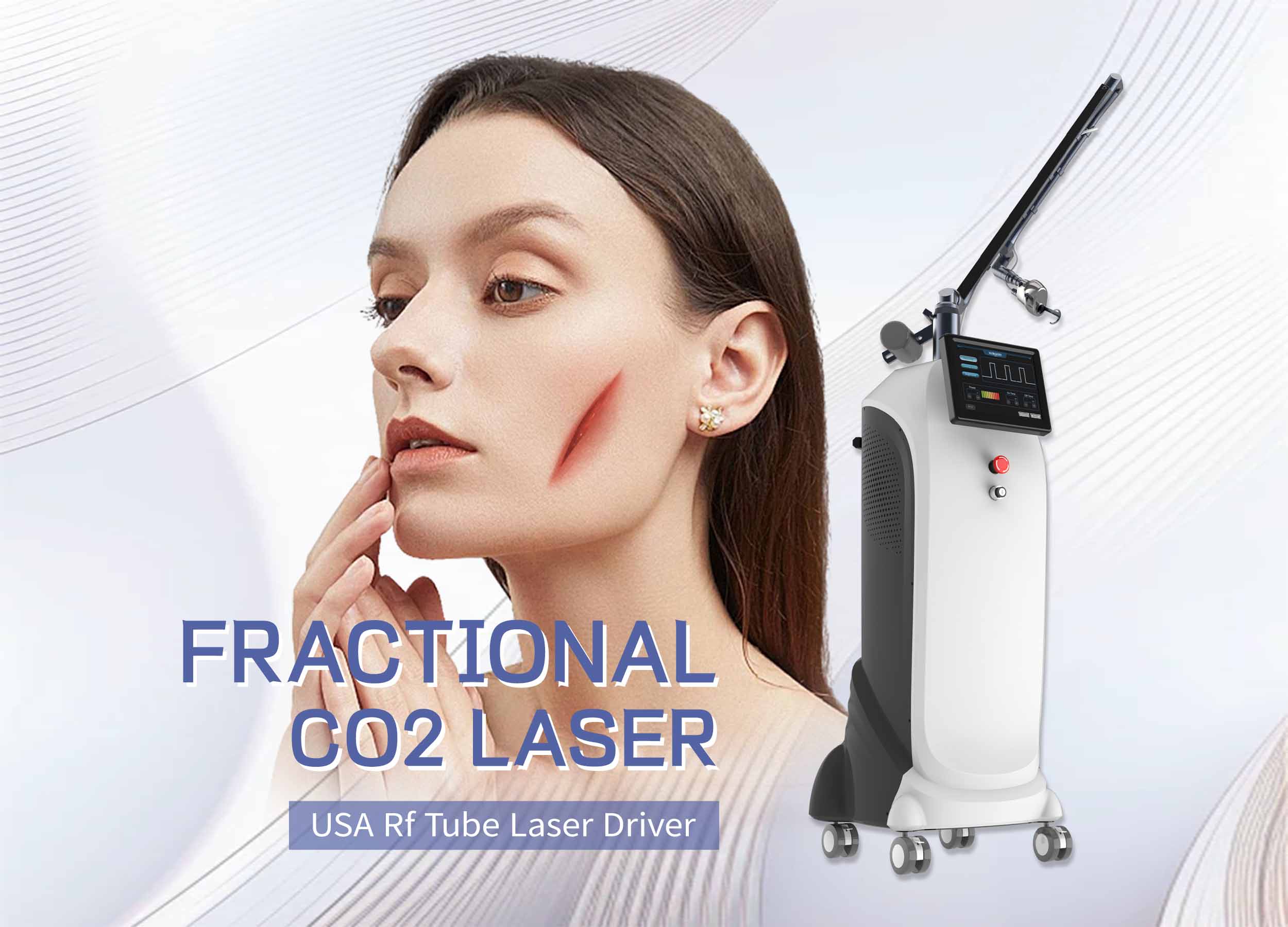
In addition to tattoo removal, this device is also equipped with dot matrix hand tools.
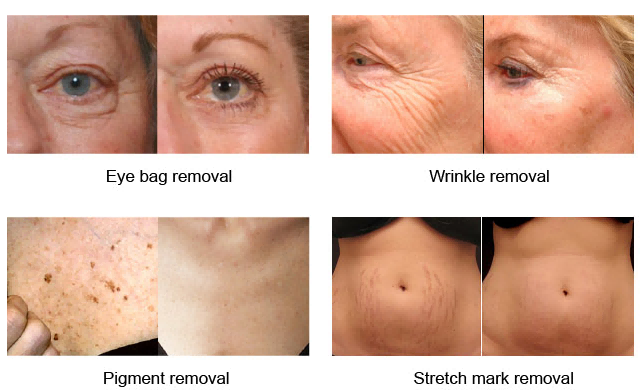
When the tattoo area is too large, or the patient himself is accompanied by large pores, acne pits, and old surgical scars in the tattoo area, the dot matrix mode can play a role. It divides the laser into thousands of microbeams to create tiny thermal damage bands (MTZ) on the skin, stimulate the skin to activate the healing mechanism, and regenerate collagen in situ.
The auxiliary value of tattoo removal: After the tattoo pigment is basically removed, for residual slight marks or superficial scars left by old-fashioned lasers, the dot matrix mode can be sharpened and repaired to restore the smoothness and flatness of the skin.
FAQ
Q: Does tattoo removal really leave no scars at all?
Any trauma that invades the epidermis has a theoretical risk of scarring, but picosecond laser reduces this risk to infinitely close to zero.
The root cause of scarring is that the depth of thermal damage reaches the reticular layer of the dermis. The pulse width and flat top beam technology of 450ps per second greatly inhibit heat diffusion. Under the premise of being operated by an experienced doctor and correct postoperative care, there will be almost no permanent depression scars or proliferative scars. A small number of individuals with darker skin may have temporary hypopigmentation or sedimentation, but they usually return to normal with skin metabolism within 3-6 months.
Q: Is it treating pain? Do I need anesthesia?
The pain is similar to being quickly bounced onto the skin by a small rubber band, accompanied by a slight tingling sensation.
Most people can tolerate it without the need for complex injectable anesthetics. Before treatment, a 30-45 minute topical anesthetic cream is usually applied. Compared to traditional nanosecond lasers, the pain is reduced by approximately 50%, and the recovery period is extremely short. After treatment, there is a slight burning sensation immediately, like sunburn, which can be relieved by applying ice for 20-30 minutes.