
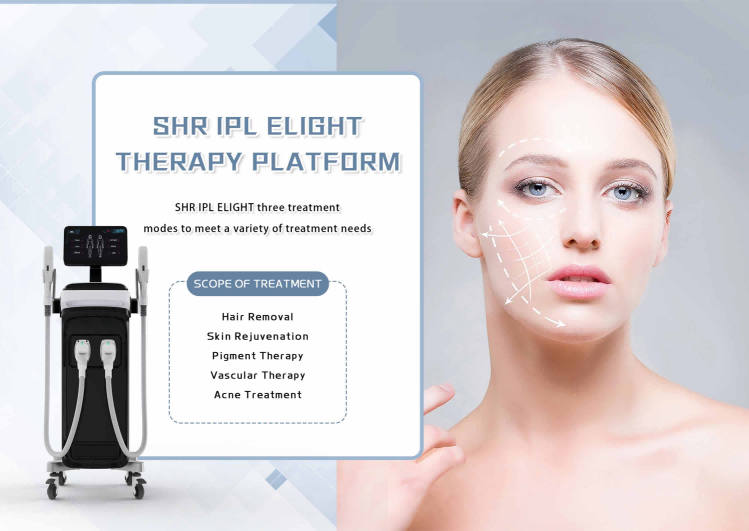
With the popularization of home beauty devices and the iteration of beauty salon technology, IPL devices are no longer the single function machines used only for hair removal. Nowadays, IPL devices, especially advanced models that combine SHR ultra pulse hair removal technology, have evolved into a multifunctional beauty platform that integrates hair removal, skin rejuvenation, freckle removal, redness removal, and even acne treatment.
However, faced with the dazzling array of IPL devices on the market, many consumers are often confused by marketing terms such as unlimited light output and freezing point below zero. As a practitioner, I must tell you that when choosing an IPL photon skin rejuvenation device, whether for home use or for beauty salons, don’t look at its appearance, don’t listen to gimmicks, just focus on three core indicators: light output frequency, wavelength range, and cooling technology.
1. Light Output Frequency: Not Only For Lifespan, But Also For Ensuring Energy Stability
The number of light output times usually refers to the service life of the core consumable in IPL equipment – Xenon Lamp. This is the most intuitive data to measure the endurance and consumable cost of an IPL instrument.
1.1 Why is the frequency of light emission so important?
The principle of IPL is to store electrical energy through a capacitor and then instantly release it to a xenon lamp, causing it to emit high-intensity pulsed light. Every flash is a loss of xenon lamp material.
Low end devices: often use small diameter, low-quality xenon lamps with less light output times. For beauty salons, it may take several months to replace the light tubes, which is costly.
High end equipment: using large-diameter (such as 9MM diameter) high borosilicate or specially designed xenon lamps, combined with high-capacity capacitors (such as 3 high-capacity capacitors in parallel), its lifespan can reach more than 1 million times.
1.2 What’s the Meaning of Million Light Emissions
When a device claims a one million light emissions, it doesn’t just mean you can use it for a long time. The deeper significance lies in:
Extremely low energy attenuation: High specification xenon lamps combined with silver plated chamber technology can ensure stable energy output. Only with stable energy can each pulse effectively target hair follicles or skin tissues.
Support high-frequency therapy: Only lamps with a long total lifespan can withstand high-frequency continuous flashes in SHR mode. If the lifespan of the lamp is short, it will quickly become unusable in high-frequency mode.
2. Wavelength Range: Determines What Skin Problems You Can Solve
Wavelength is the soul of IPL. Many users complain that photon rejuvenation has no effect, and 90% of the reason is due to the wrong wavelength selection. IPL is not a single wavelength laser, but a range of wavelengths of light. By using different filters, we can capture light of different wavelengths to deal with different skin problems.
2.1 Targeted Effects At Different Wavelengths
400nm-530nm: mainly targeting superficial pigments such as sunspots and freckles. But this light contains a lot of ultraviolet components, which can cause significant damage to the epidermis, and is easily absorbed by melanin competition, which can easily lead to burns. Attention when purchasing: If a device does not mention wavelength at all and only has this band, it should be used with caution for people with dark skin.
530nm-650nm: This is the ideal wavelength range for treating redness and acne. The oxygenated hemoglobin in the blood has an absorption peak in this band, which can block dilated capillaries.
650nm-1200nm: This is the golden wavelength range for hair removal and deep skin rejuvenation. Melanin still absorbs in this wavelength range, but penetrates deeper and can reach the root of hair follicles directly. Due to avoiding the competition peak of epidermal melanin, long wavelength hair removal is safer and less prone to blackening.
3. Cooling Technique: Say Goodbye To Pain, The Key To Ensuring Safety
3.1 Why Is Cooling Necessary?
When high-energy light penetrates the skin, melanin in the epidermis inevitably absorbs some of the light energy and converts it into heat energy. If not cooled down in a timely manner, the temperature of the epidermis will rise sharply, leading to severe pain such as being splashed with hot oil or rubber bands bouncing violently. Side effect risks: blisters, burns, and even postoperative pigmentation.
3.2 Real Experience of Sapphire Contact Cooling
The crystal at the front end of the handpiece of a truly experienced device is usually a quartz crystal or sapphire crystal.
When this crystal is cooled to near 0 ℃ (or even lower) by a powerful semiconductor chip, two things happen when it comes into contact with the skin:
Pre cooling: Before the light comes out, the skin is already cooled down, raising the pain threshold and making you less sensitive.
Skin protection: The heat generated at the moment of light emission will be quickly sucked away by the cold crystals pressing on the skin, that is, heat backflow. This achieves a low-energy, high-frequency flash mode, ensuring that the hair follicles are heated and the epidermis remains unharmed.
4. Technological Upgrade: The Revolutionary Experience Brought By SHR Mode
Traditional IPL adopts a high-energy, single strike mode, which is effective but causes pain (high energy, strong pain sensation). And SHR adopts a low-energy, high-frequency, fast sliding mode.
Speed: With 15 * 50mm light spot and 10Hz high frequency, you can quickly slide on the skin like a facial mask in SHR mode. Removing one calf may only take 5-8 minutes.
Comfort: Due to its low energy and the aforementioned sapphire freezing point, SHR is almost painless.
Safety: Low energy avoids the risk of instant epidermal burns, especially suitable for people with darker skin or thinner skin.
Effect: By accumulating heat multiple times, the temperature of hair follicles slowly increases to 45-65 degrees, which is enough to destroy hair follicle stem cells without causing severe pain. This is what is called effective absorption, without damaging the epidermis.
FAQ
Q: After using IPL hair removal, does the hair no longer grow? Is it permanent?
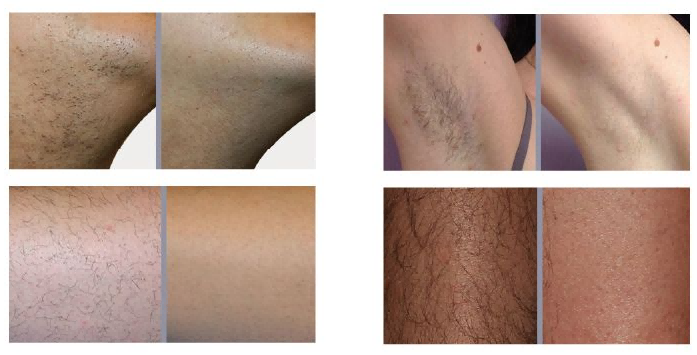
Strictly speaking, IPL achieves long-lasting hair reduction rather than complete hair loss where not a single hair grows. After a complete course of treatment (usually 8-12 times), most of the hair follicles in the growth stage will be destroyed, resulting in extremely slow hair regeneration, lighter color, and finer texture. Subsequent maintenance may only require 1-2 times a year. In international standards, the definition of permanent also refers to a significant extension of the hair regeneration cycle.
Q: My skin is dark. Can I use this IPL?
There is indeed a certain risk for people with dark skin to use IPL, as melanin in the skin competes with hair follicles to absorb energy. However, devices that use long wavelength filters (such as specialized hand tools for dark skin) and SHR low-energy high-frequency sliding technology greatly improve the safety of dark skin. The key is to increase the energy from low to high and conduct spot testing in the skin testing area first. Never use short wavelength, high-energy modes on dark skin.