
Choosing a laser hair removal dark skin protocol calls for careful assessment of both the patient and the exact device. Wavelength, pulse settings, cooling, treatment area, skin condition, operator training, and follow-up all belong in the discussion. A product feature or broad marketing phrase cannot establish that a treatment is suitable for every person or risk-free.
For clinics, the practical question is not simply which wavelength is “best”. It is whether the practitioner can assess the patient, select an appropriate protocol within their training and local scope, explain uncertainty, and document the decision. Equipment buyers should apply the same discipline when reviewing claims about wavelength and cooling. The search phrase laser hair removal dark skin should not be treated as a clinical conclusion.

What Should Clinics Assess Before Laser Hair Removal Dark Skin Treatment?
Why Does Skin Phototype Matter in Laser Hair Removal?
Skin tone and recent tanning can affect how a laser treatment should be assessed. A clinician should review the patient’s skin characteristics, hair colour and calibre, treatment area, history of pigmentary change or sensitivity, medicines where relevant, and previous responses to energy-based procedures. This information supports individual planning; it does not allow a general article to prescribe settings.
Before laser hair removal dark skin treatment, the clinic should explain expected sensations, possible temporary reactions, aftercare, and warning signs that require follow-up. A test spot may form part of the practitioner’s protocol where appropriate, but it is not a substitute for competent assessment or device training.
What Should a Consultation and Patch Test Cover?
A consultation should establish the patient’s goal, relevant history, sun exposure, previous treatments, and any factors that may affect healing. The practitioner should explain alternatives and obtain informed consent. If a test area is used, the clinic should document its location, settings, date, observed response, and the decision about proceeding.
Clear records help the team make a consistent decision rather than relying on memory. They also support a review if a patient reports an unexpected reaction. Clinics should follow current professional guidance and the instructions for the exact device in use. A documented laser hair removal dark skin pathway also helps new operators follow the same assessment standards.
How Do Wavelength and Cooling Affect Device Selection?
How Should Clinics Compare Diode Laser Wavelengths?
Wavelength is one part of a device’s design, not a stand-alone guarantee of suitability. The clinic should review the exact wavelengths available, pulse and output controls, spot size, contact method, intended use, and supporting documentation. A diode laser wavelength should be considered alongside patient assessment, treatment area, hair characteristics, and operator competence.
Some professional diode systems are marketed with multiple wavelengths. Buyers should verify that the quoted model actually includes the stated configuration and ask what clinical training supports its use. Avoid translating a wavelength list into a universal promise for every skin tone. In laser hair removal dark skin planning, wavelength selection remains one part of a wider protocol.
What Can Contact Cooling—and Cannot—Establish?
Cooling may be an important device feature, but it does not eliminate risk or replace correct technique. Ask how the cooling system operates, how contact is maintained, how temperature is monitored if applicable, and what checks operators must perform. A sistem pendingin laser dioda should be evaluated against the device instructions and service requirements.
Search phrases such as “safe for all skin types” or “painless” are not evidence. Clinics should not repeat them as fact unless the exact claim is properly substantiated for the model and intended use. Appropriate assessment, settings, training, and follow-up remain essential when planning a laser hair removal dark skin service.
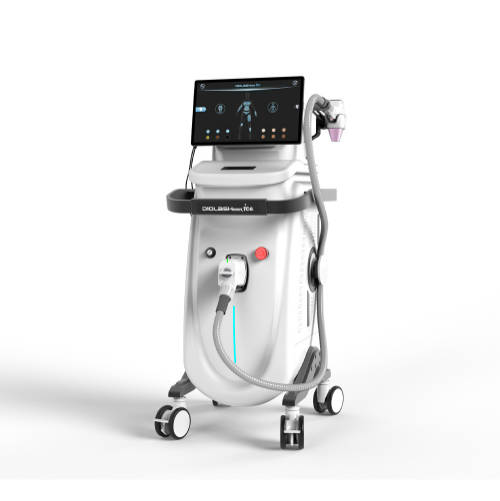
Which Diode Laser Features Should Professional Buyers Check?
Which Specifications Need Model-Level Confirmation?
A multi-wavelength diode platform may combine several wavelengths and a contact-cooling surface. These device details are not proof that one configuration is suitable for every patient. Buyers should verify the current model specification, handpiece, available controls, spot sizes, cooling operation, included accessories, intended use, and market documentation in writing.
The search phrase laser hair removal dark skin should prompt more careful questions, not a blanket assurance. Ask the supplier for the operator manual, training scope, maintenance instructions, and any model-specific supporting documents. A clinic must also follow local professional requirements.
What Training and Operating Records Matter?
Training should cover screening, device setup, treatment selection within the operator’s competence, cooling checks, cleaning, contraindication escalation, adverse-event response, and records. The clinic should retain the device instructions and ensure staff know whom to contact if equipment behaviour changes.
Ask about OEM and ODM support and after-sales assistance. Buyers should confirm how these are delivered, whether training covers the exact configuration, what languages are available, and how technical support and spare parts are arranged.
How Does Nubway Fit a Professional Hair-Removal Review?
What Can Buyers Verify About Nubway’s Diode Platform?
Nubway offers a four-wavelength diode laser hair removal machine that includes the ST808 four-wavelength configuration. Buyers can request the current model sheet and confirm the exact handpiece, wavelength configuration, cooling details, accessories, intended use, and destination-market documents before deciding. A wavelength list alone does not establish skin-type indications for a laser hair removal dark skin service.
Our ST808 diode configuration includes 755, 808, 940, and 1064 nm wavelengths and a sapphire treatment contact surface. These are equipment characteristics; they do not establish suitability for every patient seeking a laser hair removal dark skin service.
What Should a Clinic Confirm Before Purchase?
Confirm who will operate the system, what training is required, how the clinic will screen and document patients, which maintenance tasks are expected, and how service requests are handled. Include delivery, warranty, consumables, and local compliance responsibilities in the business review.
For a diode laser hair removal service, the buyer should treat patient suitability and equipment selection as linked but distinct decisions. A configurable device cannot replace clinical judgement, and a clinical protocol cannot replace accurate product documentation.
Pertanyaan yang Sering Diajukan (FAQ)
Q: Can Laser Hair Removal Dark Skin Treatment Be Used Safely?
A: Suitability depends on an individual assessment, the device and protocol, operator competence, and applicable professional guidance. A general statement cannot determine whether treatment is appropriate for a specific person.
Q: Does Cooling Make Laser Hair Removal Dark Skin Treatment Risk-Free?
A: No. Cooling may support the treatment process, but it cannot guarantee a risk-free treatment or replace suitable assessment, training, and correct operation.
Q: Which Diode Laser Device Details Should Clinics Verify?
A: Verify the exact model and wavelength configuration, controls, contact or cooling system, intended use, training, maintenance, and market-specific documentation before purchase.